How facial wrinkles form
A Brisbane-focused explainer of the biology behind facial lines — collagen change, movement, fat pads and ultraviolet light — without promising that any treatment will reverse them.
By the Anti Wrinkle Brisbane editors · Published 11 February 2025 · Updated 18 September 2026
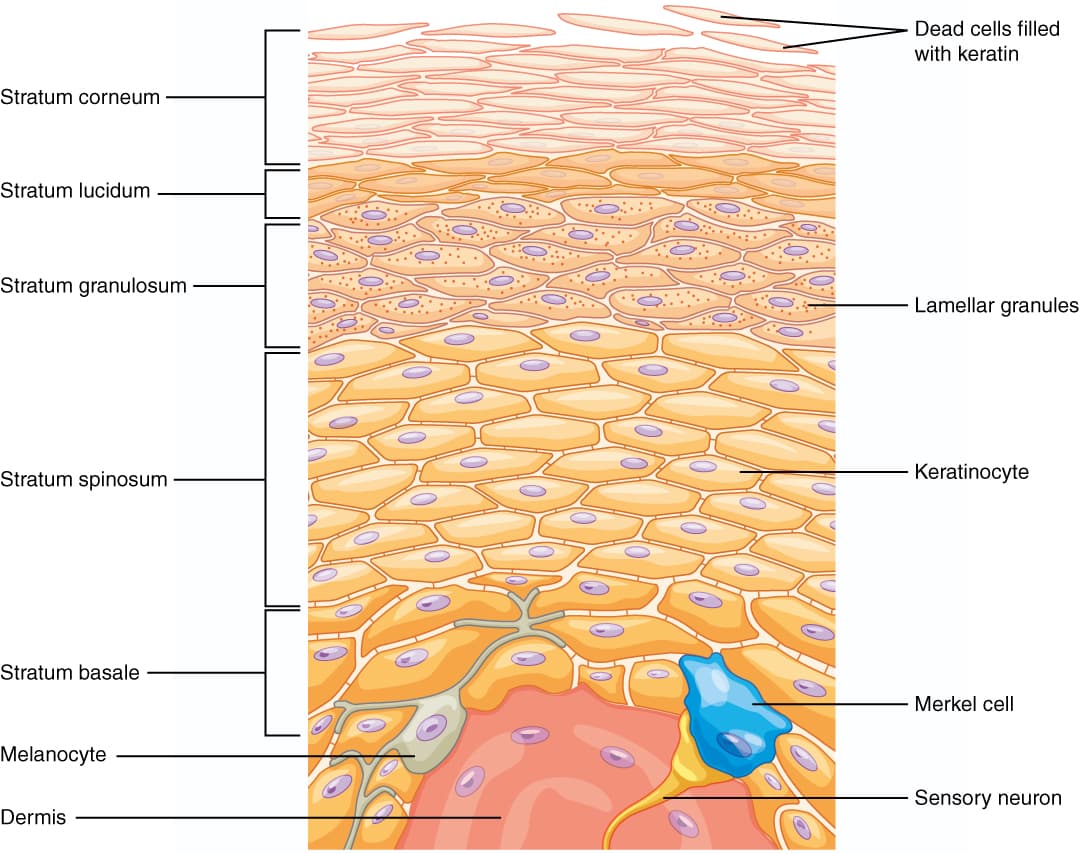
Layers of epidermis by OpenStax College. Licensed under CC BY 3.0. Source: Wikimedia Commons file page. Also listed on the image credits page.

Facial wrinkles are folds and grooves in skin that has changed with time, light and movement. They are not a moral failure and they are not a single disease. Understanding the parts that create them is the least sensational way to read the rest of this site.
This piece sits in the facial ageing hub. It does not rank clinics and it does not describe a medicine.
The skin is a stack, not a sheet
The outer epidermis renews itself. Beneath it, the dermis holds collagen, elastin and glycosaminoglycans that give skin its spring. Deeper still, fat pads and bone set the landscape those layers drape over.
When people say a line “appeared overnight”, they are usually noticing a threshold. The underlying change was gradual. OpenStax-style diagrams of the epidermis make the stack visible; a photograph of the surface does not.
For a labelled tour of those layers, continue with collagen, elastin and the skin barrier.
Movement writes some lines, not all of them
Muscles of facial expression fold the skin thousands of times a year. Over time, a crease that only showed when you frowned can remain visible at rest. Clinicians often call those pairs dynamic and static. The distinction matters because it changes what a consultation is even about.
It does not follow that every static line should be treated, or that treating movement is appropriate for every face. Read dynamic and static lines before you borrow clinic vocabulary.
Ultraviolet light changes the dermis
Chronic sun exposure produces a recognisable histology: solar elastosis, a tangle of degraded elastic material in the upper dermis. Brisbane’s latitude and outdoor culture make that pathway ordinary, not exotic.
Sunscreen, hats and shade do not “erase” existing elastosis. They reduce further injury. That is a prevention claim with a different evidence standard from a cosmetic outcome claim, and we keep them separate. See Brisbane sun, humidity and skin ageing and Queensland sunscreen and UV.
Volume and bone shift the drape
Cheeks, temples and the jawline are not static mannequin parts. Fat compartments descend or shrink. Bone remodels. Skin that once looked supported can fold even if the epidermis is carefully moisturised.
This is one reason a conversation about the mouth or mid-face is not the same as a conversation about a forehead line. Lip and perioral ageing consultations covers that geography without advertising a product.
Everyday chemistry still counts
High sugar intake feeds glycation of collagen. Smoking impairs microcirculation. Sleep position can crease the same cheek every night. None of these facts justify a miracle cream. They do explain why two people of the same age look different on the same street in West End.
We revisit the biochemistry in glycation, sugar and skin and the habit list in natural skin-care habits that still hold up.
What this does not tell you to do
If you are weighing a clinic visit, the next useful page is considering a cosmetic facial treatment, then what happens in a cosmetic consultation. Bring questions, not a screenshot of someone else’s face.
Individual skin behaves differently. No paragraph here is a treatment plan.
Questions readers ask
Are wrinkles only caused by facial movement?
No. Repeated movement contributes to some lines, but ultraviolet light, smoking, sleep position, loss of fat and bone support, and the natural decline of collagen and elastin all play a part. A consultation should start with that mix, not a single product name.
Do wrinkles mean the skin barrier has failed?
Not necessarily. The barrier can be intact while deeper dermal structure has changed. Dryness can make lines look sharper without being the original cause. That is why moisturiser and sunscreen are everyday tools, not proof that a clinic treatment is required.
Can I tell dynamic lines from static lines at home?
You can make a rough observation — some lines deepen only when you frown or smile — but lighting, swelling and makeup change what you see. A registered practitioner uses that distinction as one input, not as a diagnosis you should run on yourself.
Why does Brisbane sun matter so much?
South-East Queensland has a high ultraviolet index for much of the year. Cumulative UV is a major driver of dermal elastosis. Shade, clothing and sunscreen sit upstream of any later conversation about procedures.
Image credit for this article is also collected on the credits page. Corrections go through the contact form.
Keep reading

Considering a cosmetic facial treatment
A pause page for people who have started searching Brisbane clinics — motives, timing, health history and the difference between curiosity and a booking.

Glycation, sugar and skin
What glycation does to collagen, how the old Anti Wrinkle Brisbane lifestyle post fits modern evidence, and why this is not a detox story.
Brisbane sun, humidity and skin ageing
Why South-East Queensland’s ultraviolet index and humid summers change facial ageing, and which everyday protections are worth discussing before any clinic visit.